Tuesday, July 26, 2016

Hyder, Alaska

Our next stop will be Hyder, Alaska.  Getting there isn't exactly a straight line but that's part of the fun. We will travel back to British Columbia and Yukon Territory before crossing the border crossing the border at Stewart, BC. A 700 mile drive that will hopefully take us to a salmon filled river and some up-close views of Grizzlies.

Just a few miles from Skagway, we spotted the White Pass & Yukon Railroad train heading north.


We saw a sign along the road for a bakery advertising sourdough bread so we stopped in Carcross to stock up. The scones and sourdough bread were AMAZING and we enjoyed everything for several days.

We took Hwy 8 from Carcross which is a small shortcut over to the Alaskan Hwy then south on Hwy 37, the Cassiar Hwy. 


We stopped to take a couple photos of this gold mine. The trammel had the name of the mine, Holloway Bar, so I checked the internet and found the owners had made YouTube videos in 2011. Click on the link below to go to the first of four videos.

A few miles down the road, we came across the Cassiar Mountain Jade Store. At first, it seemed to be a typical tourist trap it have to admit it was interesting watching a stone cutter working in the outdoor work-shop. Inside the store, there was some very nice jade products. Even though we didn't purchase anything bit it turned out to be a fun stop.


Next stop...Hyder, Alaska. Hyde is in the far southeastern corner of Alaska and home of Fish Creek, a bear watching area operated by the U.S. Forest Service. We continue south in Hwy 37 and turned westbound 37A at Meziadin Jct.  for the 40 mile drive to the Salmon River area and Hyder, Alaska. 


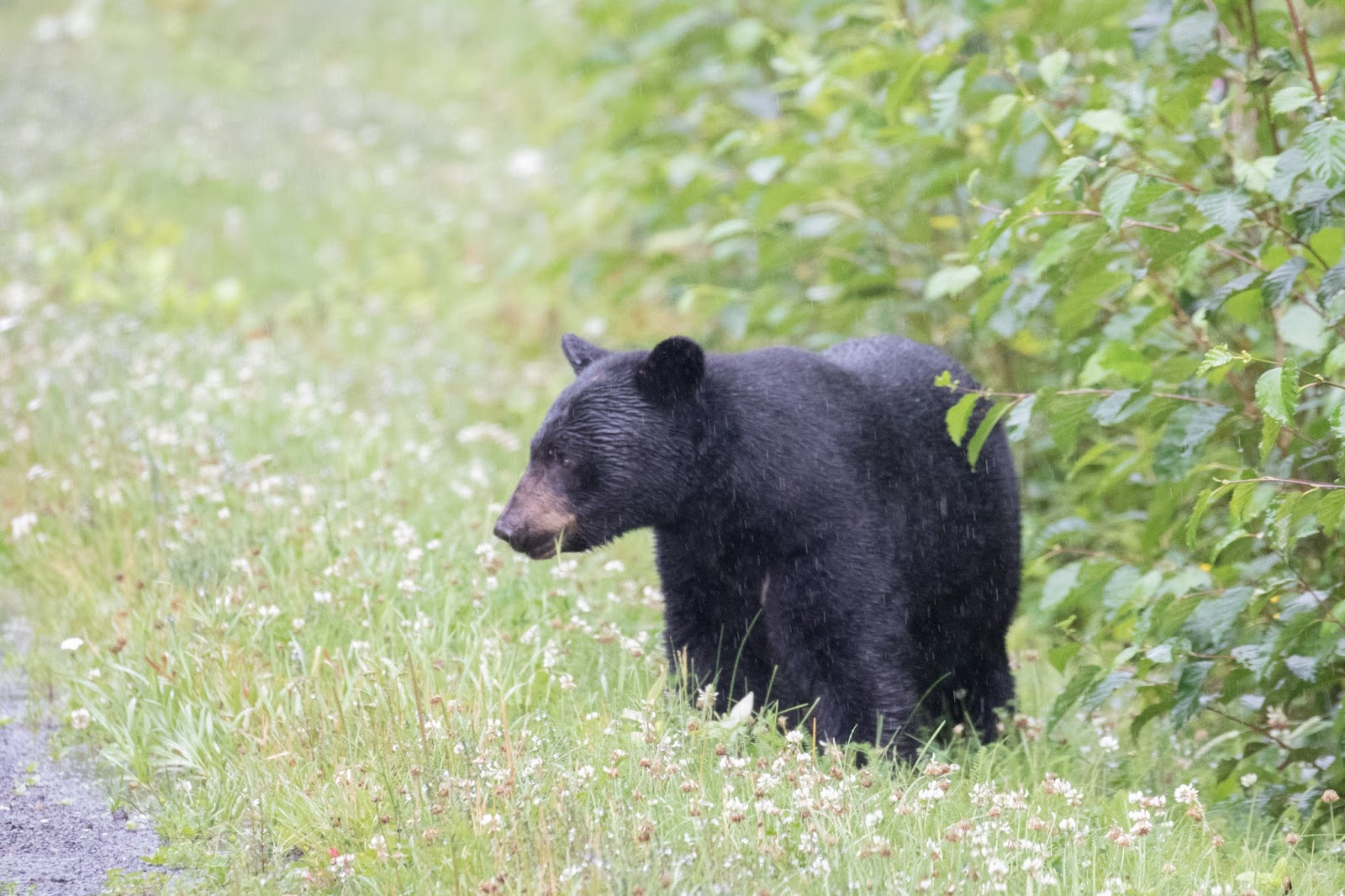
We spied a nice black bear eating beside the road...
and stopped to check out Bear Glacier...


and made it to Hyder around 3PM.


A bucket list goal was to photograph a grizzly. Last year, we looked in the Grand Teton National Park and Yellowstone Nation Park with no luck. We did spot a grizzly in Denali but it was a few hundred yards away. With any luck, this portion of the trip will yield REAL results and we can get some photos of a nice grizzly.

The Fish Creek observation site is about four miles north of Hyder on recently blacktopped road. The station is a small building along the road with parking for 20 to 30 vehicles. The admission to the viewing area is $5.00 per day of $10 for three days. We decided to go for the three day pass.


The NFS constructed a boardwalk overlooking the river in an area that draws lots of spawning salmon (and hopefully bears) each summer. Black bears and brown bears (grizzly) fish for salmon in the shallow waters as they spawn. The number of bears that come to this area is different each year – sometimes there are several bears. Eagles, beaver, wolves and other critters are regular visitors to the site.

Once on the boardwalk, it's not hard to understand why this is a favorite area to hunt for salmon. They are plentiful and the water is clear and shallow. Sometimes the salmon almost get stuck on gravel bars.

During our visit, there was a female grizzly that shows up each day between 5pm and 7pm.  Here are a few photos of her fishing and enjoying her catch. 


A beaver was working hard...

and the eagles were close by looking for pieces of salmon the bear left behind.

This eagle found a leftover salmon carcass.

Video of salmon, grizzly and eagles

We didn't know about the Salmon Glacier before arriving at Fish Creek but learned it was only a 15 mile drive up a narrow dirt road. Salmon Glacier is the fifth largest glacier in North America and since it is at 4,300 feet, it is not melting as rapidly as many other glaciers.
The top of Salmon Glacier from the lookout. It comes toward us and makes a right turn to flow down the valley.
The bottom of Salmon Glacier and it flows down the valley.
Our 12,000 year old souvenir. We brought a piece of Salmon Glacier home with us.
Hyder turned out to be a fun stop along the way. There was a lot of sitting and waiting for the grizzly but she did and she provided a fun show watching her fish for salmon. There was also some bonus photos of a beaver and quite a few eagles. Finally, Salmon Glacier was a great bonus and something that shouldn't be missed for anyone who visits Fish Creek.

Leaving Alaska for the last time.


Sunday, July 24, 2016

Skagway, Alaska

It was almost mid afternoon when we left Miles Canyon and turned our attention to Skagway, Alaska. The drive is barely over 100 miles but we would pass from the Yuking Territory to British Columbia and finally back into the U.S. just north of Skagway.


Just a few miles outside of Whitehorse, we turned south on Highway 2, the Klondike Hwy. The road was enjoyable with some great views of the mountains, lakes and a desert. Yup, we didn't expect to see a desert but there it was.

Emerald Lake.The color comes from fine glacial sediment suspended in the water.
Taglish Lake with Bove Island named after Lt. Bove of the Italian Navy.
Carcross Desert. Billed as the world's smallest desert. The sand dunes are composed of material left by a large glacial lake.

Abandoned gold mine equipment. Reminder of the Gold Rush days in the Klondike.
Our overnight spot.
About 25 miles north of Skagway, this was our home for the night. Pretty picturesque, don't you think? We would later learn this lake is called Cow Lake by many tour guides because cow moose are regularly seen here wading for food. We didn't see any moose but it was a nice stay anyway.

We woke up to rain so the mountain views would not be great. The rain and fog was widespread – DARN! But soon, we passed the U.S. border customs and arrived at Skagway.


Skagway from the overlook.
This is Skagway. Yup, that's all of it. Two main streets that are about a half mile long. Population is just under 1,000 citizens. Click on the picture to enlarge it and you'll see the entire community with the airport in the foreground and cruise ships in the harbor.

Skagway and the nearby town of Dyea were settled only because this was the northern most harbor to the gold rush. Today, tourism drives the economy. The day we arrived, there were three cruise ships in the harbor.

Cruise ships dock at the end of Main Street.
Did you know, downtown Skagway is a National Park? I had no idea. Actually, the National Parks Service has purchased a number of historical buildings and renovated them to the decor of the Klondike Gold Rush. The National Park Service provides free walking tours of several buildings and tell the story of the early days (the Gold Rush days) of Skagway.


Lots of legend surrounded Jeff "Soapy" Smith. He was a local huckster who took advantage of those who traveled through Skagway on their way to the Klondike. Soapy met an untimely death in 1898 at the age of 37 following an argument over a bag of gold that was worth $2700. Today, his parlor is a refurbished museum. 


Of course, there are bunches of sovenior stores. Tee shirts, hats and jewelry seem to be favorites. Need some mammoth tusks? Yup, you can find them. We've seen tusks for sale in several towns throughout Canada and Alaska The first time we saw them, we were surprised to learn they legal to sell. It turns out mammoths roamed this area 400,000 years ago and the cold and dry climate provided perfect conditions to preserve skeletons and tusks. Today, tusks and skeletons continue to be found by gold miners as they dig with excavators and dozers. Mostly, single tusks are found and can be purchased for $1,000 to $15,000 depending on their condition. Occasionally, a matched pair is discovered – that's when they become VERY pricey. The pair below was for sale in a Skagway jewelry store – yes the price says $101,000 and the store owner said he was confident they would sell at that price.


Popcorn is one of our favorite snack foods so we stopped to buy a bag of carmel corn. The owner was a great marketer. Look at the window under the "Popcorn" sign. See how it's cracked open?

Now go inside and find exhaust hoods with fans over the cooking area. The aroma is piped to the sidewalk. For us, that aroma is like setting swiss cheese in front of a mouse.

There is a campground in town but we decided to check out the NPS campground near Dyea (Skagway's sister city during the Gold Rush) and the nearby free campground owned by the city of Skagway. These campgrounds are about 10 miles from town but its a nice drive along the Tayia River and would allow us to explore the original town of Dyea.

Cruise ship leaving Skagway.


Our campsite at the Skagway CG. We had wood so of course we would have a s'more making camp fire.
When we heard about this campground, we didn't know what to expect. It turned out to be perfect and totally FREE.
This is a bare bones campground. Boon docking only with no electricity, no running water and no flush toilets.  OK, ready for a little info about "facilities"? Just so everyone doesn't say YUK when they hear about vault toilets, here ya go. We are self contained but there are vault toilets for those who need them and yes, they are clean and stocked with paper and hand sanitizer.


Here are a couple interesting RV's that were in our campground. One from Europe and one from South America. Notice the lift tops and the one with the folding tent on top. These units are built to travel almost anywhere and be economical on fuel.


We watched these eagles from our camp site. It was 600 years away but it was fun watching them soar.
From our camp site, we watched a pair of adult eagles sitting on their nest.
We watched them soar and train their youngsters how to fly. 
 The Skagway Campground is about ten miles north of Skagway and near the original town of Dyea. Dyea was the trailhead of the Chilkoot Trail,  a main route to Dawson City and the Klondike. Because there were too many who died in the severe conditions, the government required each miner to have one tin of provisions before they were allowed to continue on the trail. Click on the link to learn more about the Chilkoot Trail and see the list of provisions required.


Miners would make 35 to 40 trips up the trailhead to get their one ton of provisions up the mountain.
The Chilkoot Trail is hiked by those want to follow the trail of the gold miners of the late 1890's
We enjoyed the walking tour of Old Dyea. On this day, we had an armed Ranger due to a grizzly that was in the area. 
Store front. One of the last remnants of the original town of Dyea.

After leaving the Skagway campground, we stopped in town to top off with gas and filled with fresh water before heading north. Thanks to Skagway and the National Park Service for the fun and educational two days.