Sunday, July 10, 2016

Homer, Alaska

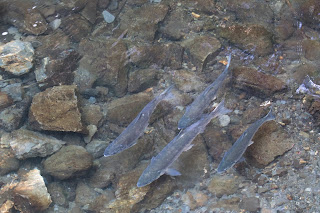
July 10 - Homer is in our sights but there are a few places to stop along the way. The first was the Cook Inlet Hatchery. The salmon are running upstream and this non-profit hatchery captures fish and milks the eggs just as they do in the hatcheries in Michigan. The fish we saw were identified as pink salmon by another visitor.


The drive is along Cook Inlet and a view of Mount Spurr, Mount Augustine, Mount Redoubt and Mount Iliama. They lie across the inlet and known as the Ring of Fire since they are active volcanos. Mount Spurr last erupted in 2009.


We saw a small church a quarter mile or so from the road. A quick check of the Milepost showed it was a Russian Orthadox church. There is a small cemetery and the church was open. Inside, there was a lady, her name was May and she told us about herself, the church and the little fishing village of Ninilchik where she grew up and raised her family. May donates her time to teach visitors about the area.


The church was on a hilltop overlooking the village so we drove down to the and discovered many eagles flying back forth. I guess where there are fish to eat, the eagles will gather.  Ninilchik was a nice stop.

We arrived in Homer and stopped by the visitor center. We do that whenever possible just to get out bearings, pick up local maps and learn what is suggested to see. We are told about the farmers market, the eagles nest across the street from the post office, the Skyline Drive overlook and of course, the famous Homer spit which is a narrow piece of land that juts out into the Kachemac Bay. 


The spit is teaming with people and parking is at a premium. We found a choice parking spot near the Lands End Motel and walked out on the beach to watch some folks fishing from shore. 


Homer is known as the halibut fishing capital so those who want to bag a large halibut will charter a boat like this. The charter business is booming during the summer.


We ended the day at the Skyline Drive overlook and took photos of overlooking the bay and spit.

We saw no No Camping signs so we settled in for the evening but I couldn't help setting my camera up for a midnight photo of Homer and Kachemac Bay. It's "sort of dark" but this is Alaska and dusk is about as dark as it gets


Have you noticed all the Alaska shows on TV lately. Ice Road Truckers, Alaska State Troopers, Alaska: The Last Frontier. This list goes on but a couple years ago, when we decided to do an Alaska trip, we started watching some of them. Alaska: The Last Frontier that featured the Kilcher family. Of course the show has a bit of hollywood but the Kilchers still actively farm the 600 acres so we drove the 11 miles to tour the farm and learn how Yule Kilcher came to settle on that land and raise a family of eight is a little log cabin. 


We got there early and but were met bay one of the family members who told us to look around and take a walk down to the bay if we wanted. We walked maybe a half mile (all downhill) and knew we would have to make the trek back up so we didn’t make it all the way to the bay. Hay is their biggest crop. It's a mix of timothy grass and clover and they have to make enough to feed the 250 or so head through the winter. In the summer, the cattle free range at the head of Kachemac Bay.


But the scenery was great and the view of the glacier across Kachemac Bay gave an indication why Yule Kilcher decided to settle on this spot.

Yule's grand daughter talking the history of the Kilcher homestead.
After the tour, we saw Otto Kilcher, the son of Yule and one of the stars of the show, putting air in a flat tractor tire. If you watch the show, you know how Otto is a make-do sort of guy so in true fashion, his air tank was made of an old LP tank. We stopped for a moment to introduce ourselves and he was kind enough to let us take a picture before going back to put air in the tire. 


Well, the tire wasn’t exactly new so air came out almost as fast as it went in. In stride, he said well I think I have another wheel and tire...I’ll just have to change it. So if you happen to watch the Kilcher’s show, yes it really is a working farm.

We drove back into town to drive the spit one last time and check out the farmers market. It was fairly small and had a few produce stands but mostly, it was baked goods, home made jams & jellys and crafts. We only bought some jelly - tart cherry and moose berry (they called them high bush cranberries).


Our pleasant stay in Homer came to an end and we headed back up the Sterling Highway. Next stop, Denali.

Thursday, July 7, 2016

On to Homer

July 5
Onward to Homer. Actually, it would take us a few days to make it to Homer. There is only one main road to Valdez so we backtracked up Hwy 4, the Richardson Highway. Generally, we don't like to backtrack but this time it's welcomed since this stretch of road offers such a spectacular scenery with the mountains and waterfalls. We joined the Hwy 1, the Glenn Highway, that would take us to Wasilla where we stayed with friends for a few days.

We had promised Sofie, a long time friend of Carolyn’s parents, that we would make it to Alaska and stop to see her. Sofie has been in Wasilla for twelve years. She moved here to live with her son and daughter in law after her husband Dick passed away some fifteen years ago. It was great seeing her and even better to see the joy we brought to her. We received a bonus of a great halibut dinner Larry cooked for us. Thanks to Sophie, Larry and Jean for your hospitality.

Since our hometown Bowling Green State University Falcons play University of Alaska Anchorage and U of A Fairbanks, we decided to take a look at the rinks where they play when they come north. We found the ice rink on campus and talked to Josh (one of the assistant coached) and learned this was only the practice rink – games are played at the Sullivan Arena which is only a couple miles away so off we went to find the Sullivan.


Mission accomplished so we headed south on Alaska 1, the Sterling Highway. The drive took us along the Cook Inlet, a drive we thoroughly enjoyed the drive. We took the cutoff toward Whittier to take a peak at the dual tunnel. Dual tunnel? Well, tunnel expensive to build so this single tunnel serves both trains and motor vehicles. They take turns. Who’s going to argue with a train but the system seems to work pretty well. It’s $13 toll each way for cars and smaller RV’s such as our Roadtrek but we decided to pass on the $26 round trip. Instead, we became aware of the numerous glaciers around us so we stopped at the nearby Begich-Boggs Visitor Info Center at the Shugach National Forest.


The Ranger told us the area is a natural rain forest which had created and sustained hundreds of glaciers in the area. Some are diminishing, but others continue to sustain or even grow a bit. With the information we just learned, I stood in the parking area could see a half dozen glaciers from that single spot.

Next stop Seward. We wanted to see the town, visit the Alaska SeaLife Center and walk to Exit Glacier which is just a few miles out of town. Seward turned out to be quite a tourist town and everything was packed with people. We found a place to park in the lot right on the water and walked over to the SeaLife Center. It is a two story aquarium with fish and some sea animals such as a sea lion and seals that had been injured. It is a good aquarium but we’ve been spoiled by the brand new aquarium at the Toledo Zoo but there were a few displays that were quite good and different than we have previously seen.


The final stop in Seward was Exit Glacier. It is just a few miles out of town and only a mile hike from the parking area. It was a nice hike up to see and learn about Exit which is one of the glaciers that has receded a lot in the past one hundred year. We spent the night just a couple miles down the road at a rest area along the melt-off stream.


We were too late to book a tour but we talked to some folks who had a wonderful experience on a whale watch tour out of Seward. They had some great pics of their trip. We should have taken a a whale watching tour, we missed on that decision.

On we go to see what we can find next.

Monday, July 4, 2016

Valdez, Alaska

July 4 – Valdez
Canada Day activities in Dawson City, YT were so much fun, we decided to spend the 4th of July in Valdez, Alaska. Another small town with a lot of history.

Valdez has a natural harbor (Prince William Sound) on the Gulf of Alaska which was perfect for early ship trade so this little city played a major role in the early days of Alaskan gold mining. Later, the ports would haul supplies to build roads to Anchorage and Fairbanks.

The population was around 600 in the early 1964 when the largest earthquake in North America hit Valdez. The town was destroyed but was rebuilt just a few miles west. Some homes were moved to the new town-site but almost all of the town is new.


In recent years, Valdez has flourished and the population has grown to 4,100. The main industries are the Alaskan pipeline terminal which was completed in the 1970’s and the increased salmon fishery.

Today, was the big day. Forth of July in Valdez. I gotta say, the small city of Valdez has a jam packed schedule for the day. The helpful folks at the visitor center supplied us with a list of events...an entire page full of things to do. Except for the 5K and 10K salmon runs, all were done within easy walking distance. We started off with picking our spot to watch the parade. It was the perfect spot next to a family who had come down from Wasilla to enjoy the 4th of July on Valdez. The parade was followed by the pie eating contest. Carolyn went to that event and snapped some pictures while I finished a couple blog posts.


At 3:30, we watched the beginning of the canoe jousting but had to leave for a while to watch the Coast Guard perform a simulated helicopter water rescue. That was IMPRESSIVE. 


As soon as that finished, we went back to watch the finals of the canoe jousting.


We aren’t done yet...a folk/country band played while a free community burger dinner was served to the 2500 or so people. 


As the day started to wrap up, a bon fire was lit and everyone who wanted a s’more was able to make their own. I suspect some kids will have a sugar high that will several days.


Finally, as to fire died down, fire fire boats lined up in front of the docks to demonstrate their water canon abilities. By coincidence, there fire boat chief was standing with us and explained their capabilities. Of course, there is a huge need for fire safety when loading boats with crude oil from the Alaskan Pipeline. In addition to special fire extinguishing compounds, each water canon can pumps up the 5,500 gallons of water per minute.


Last but not least, there was a darned good fireworks display. It’s not real dark at 10:00pm in Alaska but that didn’t matter. There were ooohs and aaahs and lots of applause when the finale ended.


After all that, it was a full day and we were tuckered out. Thanks Valdez, you did well and we will remember the fun 4th of July we spent with you.

Sunday, July 3, 2016

We made it to Alaska

July 2 – Chicken, AK and beyond
After three fun days in Dawson City, we boarded the free ferry across the Yukon River and drove the Top-Of-The-World-Highway.


Renowned by travelers, it is a 62 mile dirt and gravel road that works it’s way from Dawson City on the east and the U.S./Canadian border on the west. There are some great views but one has to watch the road for pot-holes while enjoying some great views.


One of the fun parts of out traveling friends if someone is likely to pop up almost anywhere and it happened on the OTWH. We came around a corner and saw another Roadtrek parked in a pull off so we diced to stop and say hello. I’ll be darned if it weren’t Doug and Jane MacArthor who we had met at a retirement party a few years ago. We laughed, shared a couple stories, snapped a photo and were off on our adventures. That was fun!


After crossing the border, we came across Walker Fork campground. A nice Bureau of Land Management campground in the middle of nowhere. The campground host filled us in on the cost...$5.00. That included free fire wood if we wanted and he would bring it to our camp site is we wanted it. What a deal and of course Carolyn never passes up an opportunity for a camp fire.

U.S. /Canada border crossing
We found a great site and were rewarded with a rainbow. The fire was lit and we cooked foil wrapped chicken breasts on the coals. A couple of other campers walked by with their fishing poles and just a few minutes later came back with a small grayling. Here’s dinner she said...and on the first cast.


The next morning, we drove the seventeen miles to Chicken - 55 more to Tok. The roads were a mix of dirt, gravel and occasional blacktop for the next 30 miles. We would hit blacktop and be excited before being let down by more dirt or gravel a quarter mile up the road. Finally, the road turned all blacktop about 40 miles to Tok...not perfect blacktop but enough to be content with the improvement.

Whoops, in my excitement over blacktop, I forgot to talk about Chicken, Alaska. Back in the gold rush days, some miners named Chicken. Well, the town was supposed to name it Ptarmigan after a grouse like bird found in the area. Unfortunately, no one knew how to spell Ptarmigan so it became Chicken. Today, it’s mostly a tourist attraction but gold mining continues in the area. We had lunch at the Chicken Creek Cafe (also known as Sue’s place) and had...chicken of course! We topped it off with a piece of home made blueberry/cherry pie. We agreed Sue has pie making figured out!

Official mascot of Chicken, Alaska


Just outside town, we approached a couple four wheelers parked beside the road. As we slowly passed, I could see why they stopped. A cow moose was eating her breakfast in a small pond beside the road and she was gracious enough to all me to take a few pictures.


Also, soon after we left Chicken, we came around a corner and passed a Milepost car. For those who don’t know about the Milepost, it’s an annual publication that gives mile-by-mile explanations of the roads Alaskan roads. We assumed he was checking to see if there were any changes on the Taylor Hwy. We had the dash cam going so maybe we can grab a still of the car when we get home.

Tok is a town of about 4,000 residents. We stopped at the visitor center to gather some info about Valdez, our next stop and to confirm Alaska’s rules about boondocking. Yup, as long as there are no NO CAMPING signs, it’s OK to spend the night. YIPPEE, that works for us. We topped off with gas and were on our way to find a free camp site. $2.68 per gallon at the Shell station. Wow, that’s the cheapest since Montana...2,200 miles ago.

We continued on and stopped by Wrangell National Park. We talked to the Rangers in the visitor center and learned some fun facts about this beautiful Nation Park in southeastern Alaska. Wrangell NP is big, really big and will be added to our places to explore on our next trip to Alaska.

 We ended the day with a fun adventure at the Worthington Glacier. The glacier is visible for miles. We drove into the visitor parking area and learned there was a makeshift path that led all the way to the edge of the glacier. Why not, we said so off we went. We had to just some small streams of glacier melt and soon found ourselves walking through blocks of ice.


What a great experience so with that, we found a camp site and called it a day.